Why Choose Embroidery Sheer Fabric for Global Sourcing?
Global sourcing decisions are changing as buyers demand beauty, traceability, and measurable value. Embroidery Sheer Fabric answers that demand with lightweight structure, decorative depth, and flexible styling. It can transform a simple blouse, bridal panel, or window display into a detailed visual statement. Yet appearance can mislead. A beautiful swatch is not proof of responsible production.
Textile Exchange’s Materials Market Report 2024 reported 124 million tonnes of global fiber production in 2023. It projects production could reach 160 million tonnes by 2030. This pressure makes fabric selection more important. Buyers should examine fiber content, embroidery backing, dye methods, supplier audits, and minimum order quantities. The World Trade Organization also identifies textiles and clothing as major traded manufactured goods. That scale creates opportunity, but it increases supply-chain complexity.
Transparency matters. Fashion sustainability advocate Orsola de Castro has said, “The most sustainable garment is the one already in your wardrobe.” Her reminder applies to sourcing decisions. Durable Embroidery Sheer Fabric can support longer product life when its construction matches the end use. Test the edge first. Check snag resistance, colorfastness, shrinkage, and embroidery stability. A laboratory report helps, but hands-on inspection still matters.
Global sourcing is not automatically better. Shipping distance, unreliable documentation, and rushed sampling can weaken the business case. Responsible buyers compare landed cost, verified production conditions, and practical performance. The strongest choice is rarely the cheapest roll. It is the fabric that performs beautifully, arrives consistently, and withstands honest questioning.
What Is Embroidery Sheer Fabric?
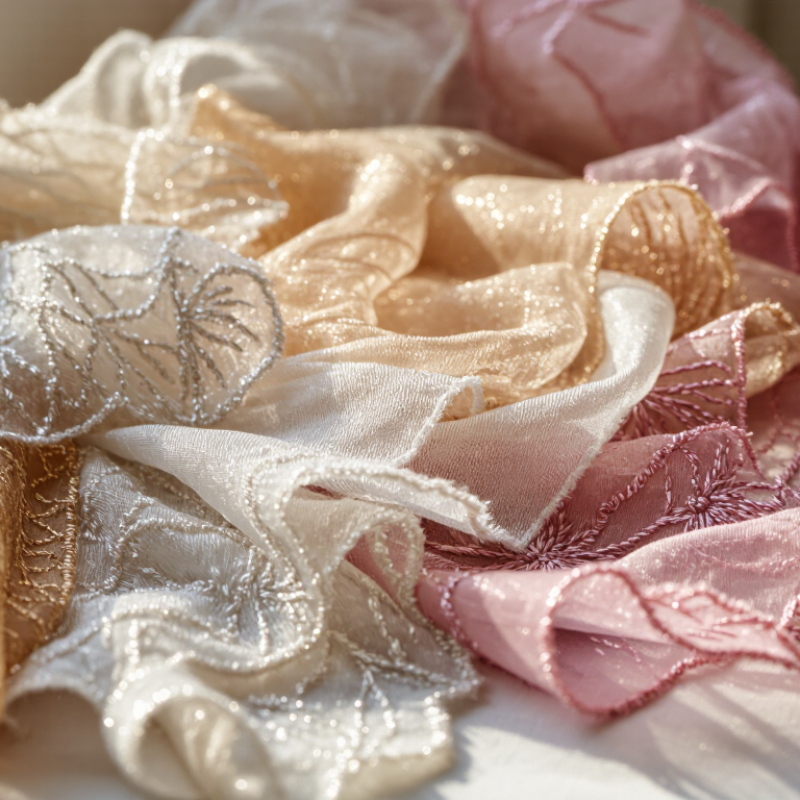
Embroidery sheer fabric is a lightweight textile with decorative stitching on a translucent base. The ground may be tulle, mesh, voile, chiffon, or fine organza, depending on the intended drape. During production, embroidery threads form flowers, vines, geometric lines, or small raised details across the surface. The base remains partly visible, creating a soft, airy appearance rather than a solid printed effect. Some fabrics include sequins, beads, or appliqué, but added weight can change performance.
For global sourcing, buyers should examine fiber content, fabric width, stitch density, and finishing methods. A dense design can look luxurious, yet it may snag more easily during cutting and sewing. Check it in daylight. This reveals uneven transparency, skipped stitches, loose threads, and color differences between the base and embroidery. A reliable supplier should provide measurable specifications, shrinkage results, colorfastness data, and a pre-production sample. These records make comparison easier across factories and seasons.
The fabric suits overlays, sleeves, panels, veils, and decorative home-textile details. Its appeal is visual, but comfort and durability need equal attention. Some sheer grounds feel crisp; others feel slippery or fragile, affecting handling. I would not judge quality from photographs alone. Photographs hide stiffness, rough thread ends, and the fabric’s response to pressing. Not every uneven stitch is a defect, especially in handmade-looking designs. Repeated flaws, however, may indicate weak process control. That distinction deserves careful discussion before a large order.
Why Choose Embroidery Sheer Fabric for Global Sourcing?
What Is Embroidery Sheer Fabric?
| Data Dimension | Typical Information | Why It Matters in Global Sourcing | Sourcing Consideration |
|---|---|---|---|
| Fabric Definition | A lightweight, partially transparent textile decorated with stitched motifs, patterns, or borders. | The fabric combines visual delicacy with decorative value, making it suitable for fashion, interiors, and special-occasion products. | Confirm the base construction, embroidery density, backing, and intended end use before ordering. |
| Common Base Fibers | Polyester, nylon, cotton, rayon, silk, and blended constructions are commonly used. | Fiber selection affects cost, appearance, care requirements, durability, and import documentation. | Request fiber-content verification and check whether the material meets the destination market’s labeling rules. |
| Typical Fabric Weight | Often approximately 30–180 g/m², depending on the base fabric, thread type, stitch density, and attached embellishments. | Weight influences drape, shipping volume, garment structure, and the amount of support needed during production. | Use a measured sample or approved specification rather than relying only on a general product description. |
| Transparency Level | Ranges from lightly translucent to highly sheer; embroidery can create opaque or semi-opaque visual areas. | Transparency affects lining decisions, garment layering, privacy, and the final appearance under different lighting. | Evaluate samples over light and dark backgrounds and under both natural and artificial light. |
| Embroidery Types | Floral, geometric, botanical, border, all-over, cutwork, applique, and raised or textured designs. | Design variety supports different product categories and enables visual differentiation without changing the base fabric. | Specify repeat size, motif placement, stitch density, thread color, and acceptable design variation. |
| Typical Fabric Width | Common commercial widths are often about 110–150 cm, although decorative borders and specialty constructions may differ. | Usable width influences marker efficiency, cutting waste, material consumption, and landed cost. | Confirm finished usable width after embroidery, selvage allowance, washing, and any edge treatment. |
| Drape and Hand Feel | May feel soft and fluid or crisp and structured, depending on fiber, finishing, embroidery density, and thread composition. | Hand feel strongly affects perceived quality and product suitability, especially for apparel and home décor. | Compare swatches after finishing or washing because treatments can change softness, stiffness, and drape. |
| Main Applications | Dresses, blouses, veils, scarves, lingerie details, curtains, table décor, overlays, and decorative panels. | A broad application range can support multiple product lines and seasonal collections. | Match the construction and performance requirements to the product’s intended use and care method. |
| Color and Design Options | Available in solid, tonal, multicolor, metallic-effect, contrast-thread, and custom-dyed combinations. | Color and motif flexibility helps buyers adapt designs to regional preferences and different retail seasons. | Approve a lab dip or production sample and define color tolerance using a recognized color reference system. |
| Key Quality Checks | Inspect for skipped stitches, loose threads, uneven motifs, needle damage, puckering, stains, color variation, and width irregularity. | Consistent inspection reduces production interruptions, claims, rework, and customer returns. | Set measurable tolerances and use pre-production approval, in-line inspection, and final random inspection where appropriate. |
| International Shipping Factors | Important details include roll length, package dimensions, gross weight, fiber content, country of origin, and tariff classification. | Accurate documentation supports customs clearance, freight planning, landed-cost calculation, and regulatory compliance. | Confirm commercial terms, packing method, shipping documents, and destination-specific textile requirements before dispatch. |
Note: The numerical ranges shown are typical indicative ranges for embroidered sheer fabrics. Actual specifications vary by fiber, construction, embroidery design, finishing process, and supplier.