China Top Foldable Table Manufacturers for Global Buyers

Foldable Table sourcing is no longer just a search for the lowest unit price. Global buyers also weigh load capacity, packed size, finish quality, lead time, and repeat-order consistency. The opportunity sits within a much larger furniture trade. Fortune Business Insights valued the global furniture market at USD 541.52 billion in 2023 and projected it to reach USD 785.98 billion by 2032. That estimate covers furniture broadly, not folding tables alone, so it is useful context rather than a direct measure of this product category.

China remains a major manufacturing base, but supplier capabilities differ. A factory making lightweight plastic banquet tables may not be suited to compact camping designs or heavy-duty commercial models. Buyers should compare frame materials, hinge construction, tabletop thickness, packaging, and documented quality checks. Ask for a current product specification sheet and sample photos. Better still, inspect a sample under realistic use. Small details matter: a leg that locks cleanly, a smooth edge, and a table that sits level on an ordinary floor.

Trade data needs careful reading, too. UN Comtrade and World Bank WITS classify furniture through broader product codes; they do not provide a simple, dedicated global total for every type of Foldable Table. Rankings therefore depend on transparent criteria, not a single export figure. This guide examines manufacturers through product range, production focus, customization, and buyer-facing service. Some information may change between orders. Verify it directly before committing.
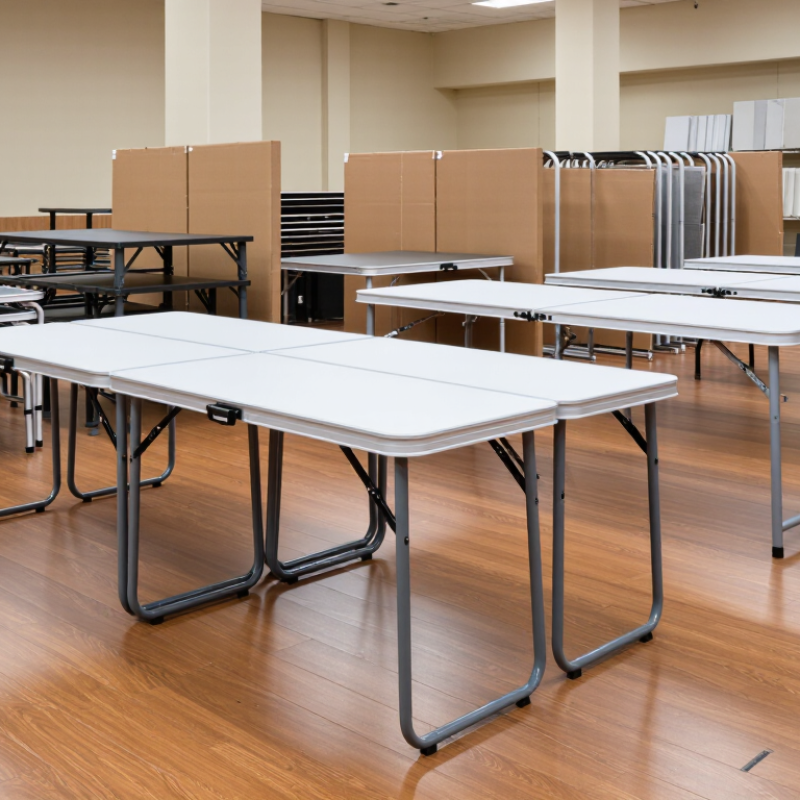
China Top Foldable Table Manufacturers for Global Buyers

China’s Foldable Table Manufacturing Landscape

China’s foldable table manufacturing landscape spans workshops specializing in metal frames, plastic tops, and complete assembly. Production commonly follows repeatable steps: tube cutting, drilling, welding, coating, molding, and final fitting. For a sample order, inspect hinge movement, leg locks, and the tabletop’s underside, not just its finish. Small differences matter.

Suppliers vary in equipment, design capability, and order size. Some build from buyer drawings; others can adjust dimensions, edge profiles, and folding mechanisms in-house. Coastal production areas may offer dense networks of component suppliers and freight services, but location alone does not establish quality. Ask for material specifications, load-test methods, carton dimensions, and packing photos. A polished sample can hide uneven welds or loose fittings.

For global buyers, compare several units for consistency. Open and close each table, then check whether its feet sit evenly on a flat floor. Confirm that steel thickness, coating, and tabletop material match the agreed specification. Lead times can shift when custom colors or tooling are involved. This is easy to underestimate. Production records and a clear inspection plan help reduce surprises, though they cannot replace checking physical samples. Some details still get missed.

Common Table Types, Materials, and Applications

Foldable tables differ by shape and workload. Banquet tables are usually rectangular, with steel legs and broad tops for catering or temporary workstations. Round models suit meetings and community dining, while compact card tables fit small rooms. Training tables often use nesting frames, so staff can clear a classroom quickly. Camping versions favor lighter aluminum frames and weather-resistant tops. Small details matter: a sharp edge or loose hinge becomes obvious after repeated setup.

Common tops include high-density polyethylene, plywood, particleboard, and metal. HDPE resists moisture and wipes clean, but can flex under concentrated loads. Plywood feels firmer; particleboard can be economical, though edge sealing deserves attention. The FAO’s Forest Products Annual Market Review 2022–2023 reports about 1.95 billion cubic meters of global industrial roundwood production in 2022. That figure describes the broader wood supply, not the quality or traceability of any table panel. Buyers should compare frame-wall thickness, hinge design, load ratings, and replacement-part availability. I would not assume lighter means better. Test it loaded. Manufacturers’ stated capacities also need careful checking against the intended use.

China Top Foldable Table Manufacturers for Global Buyers - Common Table Types, Materials, and Applications

Common Table Type Typical Materials Construction and Features Common Applications Buyer Considerations
Folding Banquet Table High-density polyethylene (HDPE) or plywood top; powder-coated steel frame Usually rectangular, with folding legs and a broad tabletop for temporary seating or serving. Banquets, conferences, schools, community events, and temporary dining areas Check tabletop dimensions, folded storage profile, frame finish, edge design, and the supplier’s stated load rating.
Folding Card Table Plastic or laminated wood top; steel legs and braces Compact square top with legs that fold beneath the surface for storage. Card games, family gatherings, craft activities, and occasional indoor seating Compare folded dimensions, leg-locking mechanism, surface cleanability, and stability on the intended floor.
Portable Camping Table Aluminum frame; aluminum, fabric, or plastic tabletop panels Lightweight design; some models use telescoping legs or a collapsible frame for transport. Camping, picnics, outdoor cooking, and travel Consider packed size, weight, setup method, corrosion resistance, and whether the surface suits food preparation.
Adjustable-Height Folding Table HDPE or plywood top; steel or aluminum legs with adjustable sections Legs can be set to different heights; many models fold for transport or storage. Exhibitions, workshops, classrooms, temporary workstations, and events Verify the available height settings, adjustment and locking method, assembled stability, and stated load capacity.
Folding Utility Table HDPE or polypropylene top; steel frame General-purpose, easy-to-clean surface with a folding leg structure; sizes and shapes vary. Food service, household tasks, markets, workshops, and temporary work areas Match the surface material to the task, and check resistance to moisture, cleaning agents, and expected wear.
Wall-Mounted Folding Table Plywood, solid wood, or laminated board; steel or aluminum wall brackets Tabletop folds against a wall when not in use; installation requires suitable wall fixings. Small kitchens, compact rooms, laundry areas, and space-saving workspaces Confirm wall construction, fixing requirements, open dimensions, bracket locking, and the manufacturer’s installation guidance.

How Leading Manufacturers Design and Produce Foldable Tables

Designing a foldable table starts with its intended use. A model for outdoor events may need a weather-resistant top and wide feet for uneven ground. A lightweight indoor table has different priorities. Engineers select the tabletop, frame, hinges, and locking parts as one system, because a strong surface cannot compensate for a loose frame. Small details matter. Rounded edges, smooth hinge movement, and feet that grip rather than scratch can change how a table feels in daily use.

Production typically turns drawings into prototypes before full-scale manufacturing begins. Teams check dimensions, fold and unfold the frame repeatedly, and apply loads suited to the table’s stated purpose. They also inspect welds, fasteners, surface finish, and whether the locks engage securely. A hinge that works on a clean sample may feel stiff after paint or coating is applied. That can frustrate users. Manufacturers adjust clearances and repeat checks, though no single test captures every real-world condition. Feedback from setup and packing trials can reveal awkward steps, such as a latch hidden beneath the tabletop. Good design makes the table compact for storage without making it difficult to open, carry, or keep steady.

Typical folding banquet tables are commonly offered in 4, 5, 6, and 8 ft lengths. The chart shows their approximate metric equivalents; actual product dimensions may vary by manufacturer and model.

Quality Standards and Export Capabilities for Global Buyers

China’s foldable table manufacturers serve buyers with varied needs, from lightweight event furniture to sturdy tables for schools and workshops. Evaluate more than the sample’s appearance. Request material specifications, drawings, and inspection records for each model. Check the tabletop thickness, frame finish, hinge movement, and locking mechanism. Ask how load capacity and stability are tested, and whether the test conditions reflect your intended use. A neat sample can still hide inconsistent production. Details matter.

Tips: Request photos or videos of hinge-cycle and stability tests. Confirm carton dimensions, protective materials, labeling, and shipping documents before placing a bulk order.

Export readiness shows in the details. A capable supplier should explain production lead times, quality checks, packing methods, and how problems are handled before shipment. Ask for a pre-shipment inspection plan and agree on acceptable defects in writing. For long-distance transport, inspect carton strength and corner protection; dents often begin there. Confirm that product information and packaging suit the destination market, and verify any applicable requirements with your local team. Communication may not always be perfect, so record specifications and changes in clear written updates.

How to Evaluate and Select a Chinese Manufacturer

Selecting a Chinese foldable-table manufacturer requires more than comparing unit prices. Grand View Research’s Office Furniture Market Size, Share & Trends Analysis Report estimated the global office furniture market at USD 63.3 billion in 2022, with projected annual growth of 5.5% from 2023 to 2030. This is useful market context, not evidence that a particular factory can meet your requirements.

Request a production sample and inspect the details that affect daily use: tube thickness, weld consistency, hinge movement, locking stability, and edge finishing. Ask how the factory tests load capacity and repeated folding, and request dated test records tied to your model. Confirm material specifications, acceptable defects, production lead time, minimum order quantity, and packaging dimensions in writing. A video tour can help, but it cannot replace a pre-shipment inspection. I would not rely on a polished catalog alone.

Tips: Send a drawing with dimensions and target load. Compare the approved sample with the first production unit. Check that carton tests reflect your actual shipping route. Small gaps in hinges can become costly returns.

Find Mitten in Michigan

Request Mitten Near You

Have a favorite dispensary that doesn't carry Mitten Extracts yet? Let us know, and we'll work to make sure our premium products are available where you shop.