China Top 10 Night Vision Lens Manufacturers
Night vision performance begins at the lens, where faint light, contrast, and fine detail must survive the journey to the sensor or eyepiece. Night Vision Lenses are used in systems for security, industrial inspection, wildlife observation, and other low-light applications. Their practical value depends on more than magnification. Optical transmission, focal length, distortion, coating durability, and compatibility with the imaging device all matter.
Market reports indicate continued investment in night vision technologies, though their estimates cover broader device categories—not lens sales alone. Grand View Research estimated the global night vision devices market at about US$7.31 billion in 2022 and projected an 8.2% compound annual growth rate from 2023 to 2030. Fortune Business Insights estimated US$7.78 billion for 2023 and forecast US$12.14 billion by 2032. The different figures reflect varying research scopes and methods. Treat them as market context, not a precise measure of lens demand.
This guide to China’s top 10 night vision lens manufacturers is intended as a practical starting point for buyers and technical teams. It considers product range, optical specifications, manufacturing capabilities, customization, and after-sales support. Check details such as coating options, mount tolerances, and test documentation; a clear catalogue image cannot confirm real-world performance. No ranking can be definitive. Supplier claims should be verified against current datasheets, samples, and application requirements, since specifications and production capabilities can change. A careful comparison may take longer, but it is more useful than choosing by price or headline magnification alone.
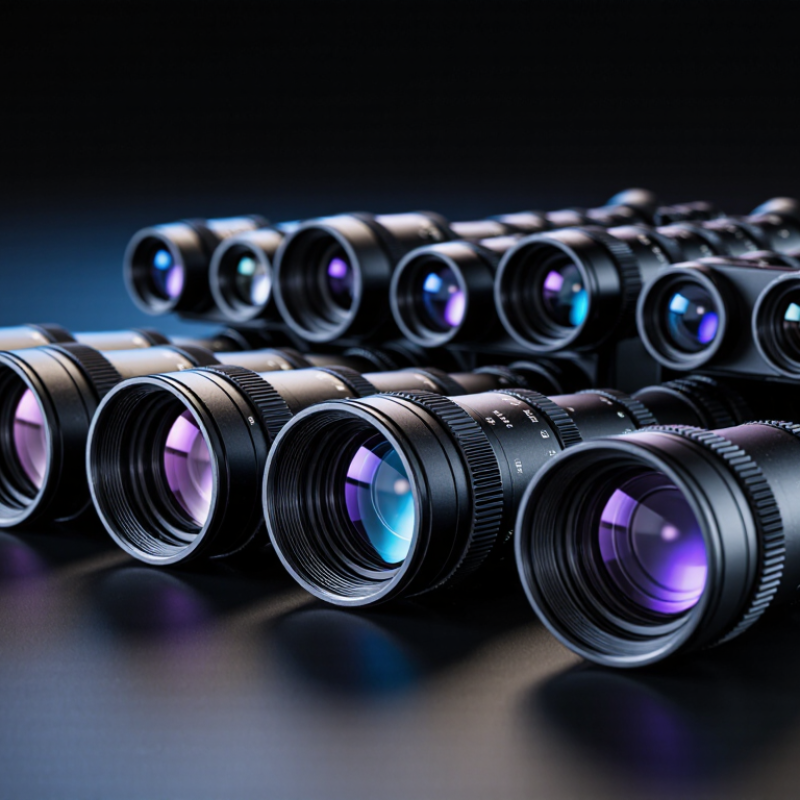
Night Vision Lenses: Principles, Types, and Key Specifications
Night vision lenses gather available light and place a focused image on a sensor. In image-intensifier systems, that image reaches a photocathode, where weak light is converted into an electronic signal. Digital night vision uses a sensor to turn incoming photons into image data. Thermal imaging works differently: it detects infrared radiation emitted by objects, so its lenses often use materials that transmit long-wave infrared, such as germanium. Ordinary glass may not work for that task.
Lens type affects what the viewer can see. A wide-angle lens covers more ground, while a longer focal length makes distant details appear larger but narrows the field of view. Fixed-focus designs are simple to operate. Varifocal lenses allow framing adjustments, though they can add weight and require careful focusing. There is no perfect lens. The right choice depends on distance, lighting, sensor size, and the intended viewing area.
Key specifications include focal length, aperture or f-number, field of view, transmission, and distortion. A lower f-number generally allows more light through, but can reduce depth of field. Check whether the stated field of view matches the actual sensor format. Coatings can reduce reflections, yet performance also depends on alignment and build quality. A lens may look clear indoors and still soften images at the edges outdoors. That trade-off is easy to underestimate.
China’s Night Vision Lens Manufacturing Landscape
China’s night vision lens manufacturing landscape combines optical design, precision machining, coating, and assembly. Suppliers may specialize in glass elements, infrared-compatible optics, or complete lens modules. Their capabilities vary, even when product descriptions sound similar. Small details matter. A coating’s consistency, for example, can affect transmission and unwanted reflections across a working wavelength range. Barrel alignment and surface quality also influence image clarity, especially in compact systems.
Manufacturers often serve both high-volume orders and smaller custom projects. This can make lead times, inspection methods, and engineering support important parts of supplier selection. Ask for measurable specifications, such as focal length tolerance, operating temperature, and coating performance, then verify them with sample testing. A datasheet alone is not enough. It may not show how a lens performs with your sensor or under changing temperatures. Communication can be uneven, too, and that deserves attention rather than assumption. For a practical comparison, review inspection records, sample images, and consistency across multiple units, not just a single polished prototype.
| China Top 10 Night Vision Lens Manufacturers - China’s Night Vision Lens Manufacturing Landscape | ||||
|---|---|---|---|---|
| Manufacturing Segment | Typical Spectral Range | Common Optical Materials | Representative Manufacturing Focus | Typical Applications |
| Visible and near-infrared objective lenses | Visible light to near-IR; often approximately 400–1000 nm | Optical glass; material choice depends on transmission and design requirements | Precision lens fabrication, centering, assembly, and spectral coating | Digital night-vision cameras, surveillance, and low-light imaging |
| Near-infrared surveillance lenses | Near-IR; commonly around 700–1000 nm | Optical glass and near-IR-compatible coatings | Designing for usable focus and transmission under near-IR illumination | Security cameras, machine vision, and infrared-assisted observation |
| Short-wave infrared (SWIR) lenses | Typically about 0.9–1.7 μm, depending on the detector | Optical glass and fused silica; material selection varies with wavelength and design | Optical design and coatings matched to SWIR sensors | Industrial inspection, imaging through haze, and specialized surveillance |
| Mid-wave infrared (MWIR) thermal lenses | Commonly 3–5 μm | Germanium, silicon, and infrared-transmitting chalcogenide glass, depending on the design | Infrared substrate processing, polishing, coating, and optical alignment | Thermal cameras, industrial monitoring, and defense imaging systems |
| Long-wave infrared (LWIR) thermal lenses | Commonly 8–14 μm | Germanium and chalcogenide glass; other materials may be used for specific designs | Thermal-imaging optics with coatings and transmission suited to the operating band | Uncooled thermal cameras, perimeter security, and temperature monitoring |
| Fixed-focal-length thermal lenses | MWIR or LWIR, determined by the detector and system | Infrared-transmitting materials selected for the spectral band | Compact optical assemblies optimized for a specified field of view | Handheld thermal devices, fixed cameras, and compact imaging modules |
| Infrared zoom lens assemblies | MWIR or LWIR, depending on system configuration | Infrared optical materials selected for the required band and zoom design | Moving-group alignment, zoom calibration, and repeatable mechanical assembly | Thermal surveillance systems requiring adjustable magnification |
| Aspheric and precision-molded optics | Visible, near-IR, or selected infrared bands | Optical glass or suitable moldable infrared glass, depending on wavelength | Asphere fabrication or precision molding to manage aberrations and component count | Compact night-vision and thermal-imaging optical assemblies |
| Optical coating and finishing services | Band-specific: visible/NIR, SWIR, MWIR, or LWIR | Substrate-dependent; coatings are selected for wavelength and operating conditions | Anti-reflection coating, surface finishing, inspection, and transmission testing | Lens production and refurbishment across night-vision imaging systems |
| Custom optical system integration | Specified by the sensor and application; may cover visible through thermal IR | Selected to match the required wavelength, environment, and optical design | Optical design, prototyping, lens-barrel assembly, and system-level testing | OEM imaging equipment, specialized observation devices, and custom camera modules |
Scope note This is a non-ranked overview of common night-vision and thermal-imaging lens manufacturing segments, not a verified company-by-company ranking. Spectral ranges and materials vary by product design, detector, and operating requirements.
How to Evaluate Night Vision Lens Manufacturers
China Top 10 Night Vision Lens Manufacturers
How to Evaluate Night Vision Lens Manufacturers
Evaluate manufacturers by measurable performance, not polished catalog images. Ask for transmission data across the wavelengths your sensor uses, plus test results for resolution and distortion. A lens may look sharp in daylight yet lose contrast in dim conditions. Request sample images from a sensor similar to yours. Check focus stability, too. Small shifts matter. A temperature change from a warm workshop to a cold outdoor site can alter focus. Ask how the manufacturer controls tolerances and checks each production batch. One sample is not enough.
Review the engineering support behind the numbers. Can the team explain how focal length, aperture, coating, and sensor size affect your image? Request drawings, inspection records, and clear specifications before comparing quotations. Confirm lead times, replacement procedures, and how design changes are documented. If possible, test several units under the same lighting and exposure settings. Record edge sharpness, flare around bright points, and performance after repeated focusing. Ask direct questions. Vague claims deserve follow-up. A detailed report can still miss real-world handling, and no checklist captures every field condition. That is worth admitting. Choose a supplier willing to discuss limitations, investigate failures, and provide consistent evidence over time.
How to Evaluate Night Vision Lens Manufacturers
Suggested evaluation weights (%) for comparing suppliers. These are a practical assessment framework, not measured rankings of specific manufacturers.
Prioritize optical performance and low-light sensitivity, then assess distortion, durability, customization, quality systems, and delivery support. Adjust the weights to match your application and procurement requirements.
Profiles of China’s Top 10 Night Vision Lens Manufacturers
Profiles of China’s top ten night vision lens manufacturers are best compared by engineering capability, not catalogue size.
Grand View Research estimated the global night vision device market at USD 7.35 billion in 2023, with an 8.3% projected annual growth rate through 2030. This growth raises demand for lenses that maintain sharpness across low-light and infrared applications. But market growth alone cannot prove a supplier’s quality.
A useful profile should disclose lens materials, coating options, focal-length tolerances, and inspection methods. Some manufacturers focus on compact molded optics; others handle larger precision-ground elements or infrared-transmitting materials.
MarketsandMarkets projected the thermal imaging market to rise from USD 4.7 billion in 2023 to USD 6.7 billion by 2028. That is an adjacent market, not a direct measure of lens sales. The distinction matters.
Ask how suppliers test transmission, distortion, and temperature stability.
Request sample measurements and ask whether results come from production units or selected prototypes. Small details matter. A polished specification sheet may omit coating uniformity or edge sharpness. That leaves room for doubt.
Compare documented tolerances, production capacity, and quality-control records before judging the ten profiles. A short trial under realistic lighting can reveal issues that a catalogue will not.
Comparing Manufacturer Capabilities and Industry Applications
China Top 10 Night Vision Lens Manufacturers
Comparing manufacturers requires more than checking lens diameter or quoted resolution. A capable supplier can explain how glass type, focal length, aperture, and coating choices affect a specific sensor. Ask for measured transmission data across the intended wavelength range. Useful evidence includes sample inspection reports and repeatability results from production batches.
Capabilities vary by application. Low-light security cameras often need fast lenses that gather light while controlling distortion near the frame edges. Automotive systems may prioritize compact housings, vibration resistance, and stable focus across temperature changes. Wildlife observation equipment benefits from clear central detail and practical focus adjustment. Thermal imaging uses different optical materials, so confirm that a supplier supports the sensor’s infrared band. Small details matter.
Request a prototype and test it with the intended sensor, not only a generic chart. Compare focus consistency, flare around bright points, and image sharpness from center to corner. Manufacturing tolerances and coating uniformity can separate two similar-looking specifications. Price still matters, but a low quotation may omit testing or calibration. One limitation is easy to miss: published specifications do not always predict field performance. Check them under real operating conditions.