10 LED Strip Lighting Tips for Global Buyers
Buying LED strip lighting for an international project involves more than comparing prices or choosing a bright color. A strip that looks suitable in a product photo may not fit the installation, power supply, or controls on site. Small details matter. Check the operating voltage, wattage per meter, cut intervals, and connector type before requesting a quotation. These specifications help prevent mismatches between the strip, driver, and planned layout.
The ten tips in this guide help global buyers assess products with practical questions and clear documentation. Review color temperature and color-rendering information for the space, whether it is a retail display, hotel corridor, or kitchen shelf. Confirm the stated ingress protection rating matches the actual exposure to dust or moisture; a rating alone does not make every installation suitable. Ask suppliers for datasheets, sample pieces, warranty terms, and applicable conformity documents. Requirements can differ by destination, so verify them with qualified local advisers or relevant authorities. Not always. A sample may look right but behave differently when paired with a dimmer or mounted in a profile. Test the intended components together when possible. Even experienced buyers can overlook heat management or voltage drop on long runs. I would not treat one specification as a guarantee of performance. Careful checks, written answers, and a small trial installation can make purchasing decisions more reliable, though no checklist replaces project-specific assessment.
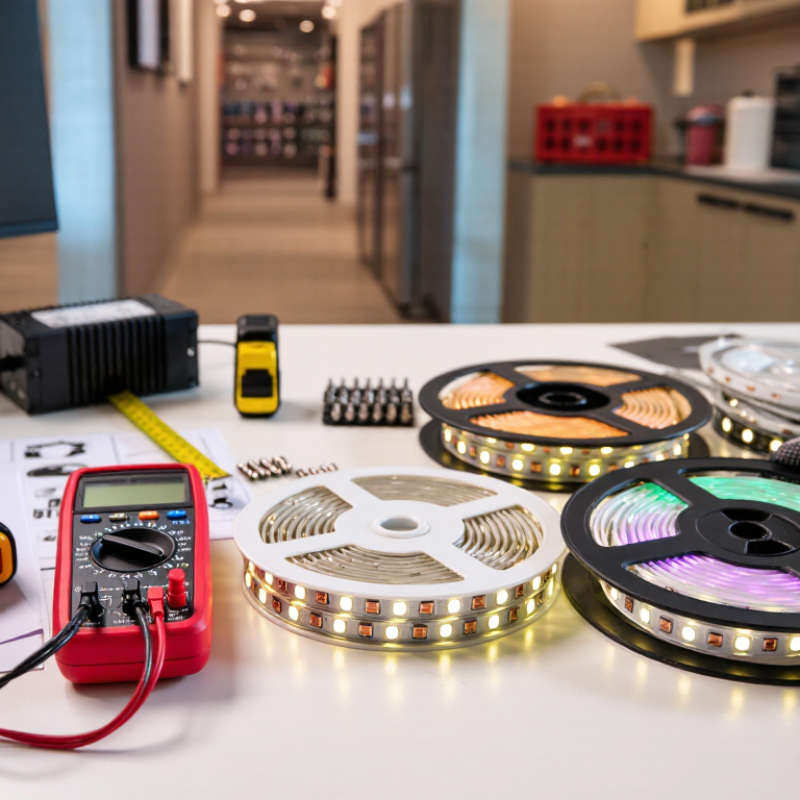
Define Brightness and Efficacy with Lumens per Meter and lm/W
For LED strips, lumens per meter (lm/m) describes the light output along each meter of strip. Multiply the rating by the installed length to estimate total output: a five-meter run rated at 800 lm/m produces about 4,000 lumens before installation losses. That does not tell you how bright a countertop will look. Distance, diffuser covers, mounting angle, and surrounding surfaces all affect the light reaching it. Details matter.
Efficacy, measured in lumens per watt (lm/W), shows how efficiently electrical power becomes visible light. Check whether the figure applies to the complete strip or only its LED components. A driver, dimmer, and heat buildup can change real-world performance. Compare products at the same color temperature and color-rendering level, and ask for test conditions. Otherwise, impressive numbers may not describe a fair comparison.
For a kitchen task area, a higher lm/m rating may provide useful brightness, while a higher lm/W can reduce power needs for similar output. Yet neither number alone guarantees comfortable lighting. A very bright strip behind a shallow diffuser may create visible hotspots. I would treat catalog figures as a starting point, not a promise; even careful calculations leave some uncertainty until the strip is tested in its actual channel and location.
| Tip | What to Check | Representative Strip Example | Light Output | Power Input | Efficacy |
|---|---|---|---|---|---|
| 1. Specify brightness per meter | Compare output in lumens per meter (lm/m), not only total lumens for an unspecified reel length. | White strip, 24 V, 5 m run | 800 lm/m; 4,000 lm for 5 m | 9.6 W/m; 48 W for 5 m | 83.3 lm/W |
| 2. Compare efficacy consistently | Calculate efficacy as lumens per meter divided by watts per meter. Compare products under equivalent test conditions. | White strip, 24 V | 720 lm/m | 7.2 W/m | 100 lm/W |
| 3. Match output to the application | Choose output for the task and installation. Lux at the work surface also depends on distance, beam spread, and optics. | General accent lighting, 24 V | 400 lm/m | 4.8 W/m | 83.3 lm/W |
| 4. Select the color temperature | Check correlated color temperature (CCT) in kelvin. Common options include warm white around 2700–3000 K and neutral white around 4000 K. | 3000 K white strip, 24 V | 800 lm/m | 9.6 W/m | 83.3 lm/W |
| 5. Check color rendering | For spaces where color appearance matters, compare the stated color rendering index (CRI); CRI 90 or higher is commonly specified for color-critical settings. | High-CRI white strip, 24 V | 900 lm/m | 10 W/m | 90 lm/W |
| 6. Confirm voltage and current | Match the strip voltage to the power supply. At 24 V and 9.6 W/m, the nominal current is 0.4 A/m; a 5 m run draws about 2 A. | 24 V white strip, 5 m run | 800 lm/m | 9.6 W/m; about 2 A for 5 m | 83.3 lm/W |
| 7. Size the power supply with reserve | Calculate total strip wattage and allow headroom. For a 5 m run at 14.4 W/m, the load is 72 W; a 20% reserve gives a minimum capacity of 86.4 W. | 24 V white strip, 5 m run | 1,260 lm/m | 14.4 W/m; 72 W for 5 m | 87.5 lm/W |
| 8. Plan for voltage drop and heat | Long runs can show reduced brightness toward the far end. Follow the manufacturer's feed-length guidance, and use a suitable heat-dissipating mounting surface. | 24 V strip for a longer installation | 1,080 lm/m | 12 W/m | 90 lm/W |
| 9. Verify dimming compatibility | Confirm that the dimmer, controller, power supply, and strip use compatible dimming methods and voltage ratings. | Dimmable white strip, 24 V | 950 lm/m at full output | 9 W/m at full output | 105.6 lm/W at full output |
| 10. Check test conditions and delivered output | Request a datasheet that states measurement conditions. Covers, channels, operating temperature, and installation can change the light reaching the target area. | White strip, 24 V, measured before installation | 1,500 lm/m | 18 W/m | 83.3 lm/W |
| Note: The figures above are representative examples for comparison, not guaranteed product specifications. Actual output and efficacy vary with LED type, CCT, CRI, drive current, temperature, test method, and installation. Efficacy is calculated as lm/m ÷ W/m. | |||||