How to Choose the Best LED Poster Screen for Your Business?
Choosing the right Led Poster Screen can shape how customers notice, trust, and remember your business. A vivid display near a store entrance may attract attention, but brightness alone does not guarantee useful communication. The screen must match your location, audience, content style, and daily operating conditions.
Start with the viewing environment. Indoor retail spaces often need controlled brightness and slim installation. Outdoor areas require stronger protection against dust, moisture, temperature changes, and direct sunlight. Check the pixel pitch carefully. A fine pitch produces sharper images at close range, while a larger pitch may reduce cost for distant viewers. Viewing distance matters more than impressive specifications.
Look beyond the screen itself. A dependable Led Poster Screen should offer stable playback, simple content updates, and compatible control software. Ask about heat management, power consumption, service access, warranty coverage, and replacement parts. These details affect ownership costs over time. They also reveal the supplier’s professionalism.
Real testing is valuable. View sample videos from different angles. Inspect text, skin tones, dark scenes, and fast motion. Stand where customers will stand. Does the image remain clear? Can staff update promotions without technical assistance?
A perfect choice is rarely available. A cheaper model may save money today but create maintenance concerns later. Conversely, premium features may remain unused in a small shop. Consider your actual goals, not only the sales brochure. Speak with qualified suppliers, request documented specifications, and compare total value before purchasing. A reliable decision balances visual impact, operating simplicity, safety, and long-term business needs.
Understanding LED Poster Screen Types and Core Features
How to Choose the Best LED Poster Screen for Your Business?
Understanding LED Poster Screen Types and Core Features
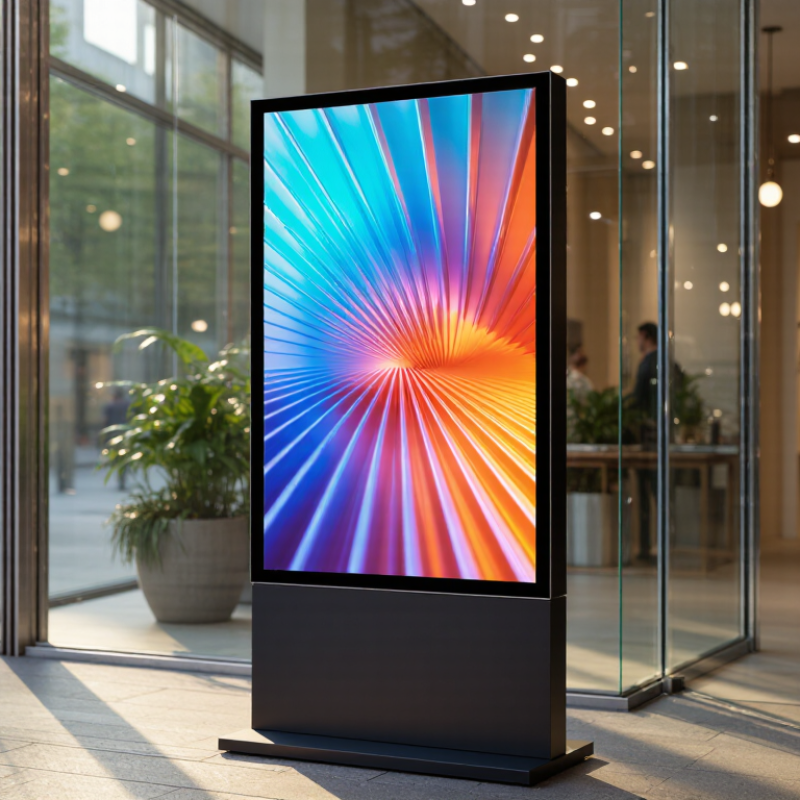
Choosing an LED poster screen begins with its location and viewing distance. An LED poster screen is a slim digital display designed for promotions, menus, announcements, or wayfinding. Common types include portable floor-standing units, wall-mounted screens, and outdoor-rated models. Portable units suit exhibitions and retail campaigns because staff can move them easily. Wall-mounted versions create a cleaner appearance in lobbies or narrow corridors. Outdoor models need stronger brightness, weather protection, and secure installation. Distance matters.
Pixel pitch affects image clarity. At two meters, a fine-pitch screen usually shows text and product images more smoothly. A wider pitch may work for viewers standing farther away. Brightness must match the environment. Too dim, and sunlight washes out the message. Too bright, and indoor viewers may feel uncomfortable. A high refresh rate helps reduce flicker in camera recordings. Look for stable color performance, wide viewing angles, and dependable heat control. A higher pixel count is not always better. It can increase cost without improving the actual viewing experience. I have seen buyers focus on resolution while overlooking ventilation.
Reliability also depends on service design. Front-access maintenance can simplify repairs in tight spaces. Check power consumption, operating temperature, mounting strength, and cable routing before purchase. Ask for test reports and clear warranty terms. Content management should support scheduled updates and common media formats. Test the screen with real content, including small text and fast-moving video. Do not judge it from a showroom loop alone. My own checklist would also include spare modules and staff training. Measure the wall. Then question the first specification sheet.
How to Choose the Best LED Poster Screen for Your Business? – Understanding LED Poster Screen Types and Core Features
| LED Poster Screen Type | Typical Pixel Pitch | Recommended Viewing Distance | Best Business Applications | Key Strengths | Important Limitations | Core Features to Check | Suitability |
|---|---|---|---|---|---|---|---|
| Indoor Fine-Pitch Poster | Approximately 1.5–2.5 mm | About 1.5–3 m | Retail stores, showrooms, reception areas, premium product displays | Sharp text, detailed images, smooth close-up viewing | Usually unsuitable for direct exposure to rain and strong sunlight | Fine pixel pitch, high contrast, front maintenance, low operating noise | Premium indoor use |
| Indoor Standard-Pitch Poster | Approximately 2.5–4 mm | About 2.5–5 m | Shopping centers, supermarkets, exhibitions, indoor advertising | Balanced image quality, cost, and viewing performance | Small text may appear less clear at very close distances than on fine-pitch models | Brightness control, viewing angle, color consistency, content compatibility | General indoor use |
| Outdoor High-Brightness Poster | Approximately 3.9–6 mm | About 4–12 m | Storefronts, outdoor promotions, transport entrances, event areas | High visibility in daylight and greater resistance to environmental conditions | Lower pixel density than indoor fine-pitch products; requires weather protection | Brightness of at least 5,000 nits for strong daylight conditions, IP-rated enclosure, temperature protection | Outdoor advertising |
| Transparent LED Poster | Approximately 3.9–10 mm | About 4–15 m | Glass storefronts, shopping mall windows, architectural displays | Allows light and partial visibility through the display while showing dynamic content | Lower contrast in bright surroundings and less suitable for detailed text | Transparency level, brightness, installation method, structural load, ambient-light performance | Window installation |
| Flexible or Curved LED Poster | Approximately 2.5–4 mm | About 2.5–8 m | Creative retail displays, exhibitions, stage backdrops, curved columns | Can adapt to curved or unconventional surfaces and create distinctive visual effects | Requires careful installation and may need custom structural support | Bending radius, panel weight, mounting system, pixel uniformity on curved surfaces | Creative installations |
| Rental LED Poster | Approximately 2.6–4.8 mm | About 3–10 m | Trade shows, conferences, touring events, temporary campaigns | Designed for repeated setup, removal, transport, and reconfiguration | May cost more initially because of reinforced frames and quick-lock hardware | Tool-free assembly, protective flight cases, locking mechanism, spare-part availability | Temporary events |
| Interactive LED Poster | Approximately 2.5–4 mm | About 2.5–8 m | Retail engagement, museums, visitor centers, product demonstrations | Supports touch, motion, camera, or sensor-based audience interaction | Higher system complexity and greater software integration requirements | Touch technology, sensor compatibility, response time, operating system, content software | Interactive experiences |
| Mobile or Freestanding LED Poster | Approximately 2.5–4.8 mm | About 3–10 m | Retail promotions, hotels, restaurants, campuses, indoor events | Easy to relocate and suitable for flexible promotional layouts | Requires stable floor support and convenient access to power | Base stability, caster design, total weight, cable management, portrait orientation | Flexible deployment |
| Energy-Efficient LED Poster | Approximately 2.5–6 mm | About 3–12 m | Businesses operating displays for long hours or across multiple locations | Can reduce operating energy through efficient LEDs and automatic brightness adjustment | Actual energy savings depend on content brightness, operating hours, and installation conditions | Average power consumption, maximum power consumption, brightness sensor, sleep scheduling, thermal design | Long operating hours |
| All-in-One Digital Poster | Approximately 2.5–4.8 mm | About 3–10 m | Advertising networks, chain stores, reception areas, promotional campaigns | Combines display, media player, control system, and enclosure in one unit | Less flexible for highly customized installations or unusual screen shapes | Built-in media player, remote content management, Wi-Fi or wired networking, scheduled playback | Simple deployment |
| Modular LED Poster System | Approximately 2.5–4.8 mm | About 3–10 m | Multi-location retail, scalable campaigns, exhibition systems, changing display layouts | Allows replacement, expansion, and reconfiguration of individual modules | Requires compatible modules, spare parts, and trained maintenance personnel | Module dimensions, cabinet compatibility, receiving-card design, spare-module strategy | Scalable projects |
Note: Recommended viewing distances are practical guidelines. The final choice should also consider ambient light, content detail, installation height, viewing angle, operating hours, maintenance access, and local electrical and safety requirements.