China Best Clogs Shoes Suppliers for Global Buyers?
Choosing reliable Clogs Shoes suppliers in China requires more than comparing online prices. A serious buyer must examine materials, factory experience, quality controls, and export reliability. A workshop may display attractive samples, yet production results can vary. That difference matters when a container holds thousands of pairs.
William A. Rossi, a respected footwear researcher, wrote, “The shoe is the foundation of human comfort.” His observation remains useful for global buyers. Comfortable Clogs Shoes need balanced weight, stable soles, smooth edges, and dependable sizing. Buyers should request physical samples, test the footbed, and inspect the bonding between the upper and sole. EVA clogs should feel flexible, not weak. Wooden styles should remain stable on hard floors.
This guide will examine Chinese suppliers that serve private-label brands, wholesalers, retailers, and distributors. It will compare product design, customization, minimum order quantities, production capacity, packaging, and communication. Factory audits and third-party inspections can reveal important details. So can simple questions about material density and mold ownership.
No supplier is perfect. Even an experienced factory can miss a color shade or delay a shipment. That reality deserves attention. Buyers should create clear specifications, approve a golden sample, and define acceptable tolerances before production. A low quotation may look attractive, but inconsistent sizing can create expensive returns. The strongest supplier is not always the cheapest one. It is the partner that delivers consistent Clogs Shoes, communicates honestly, and improves when problems appear.
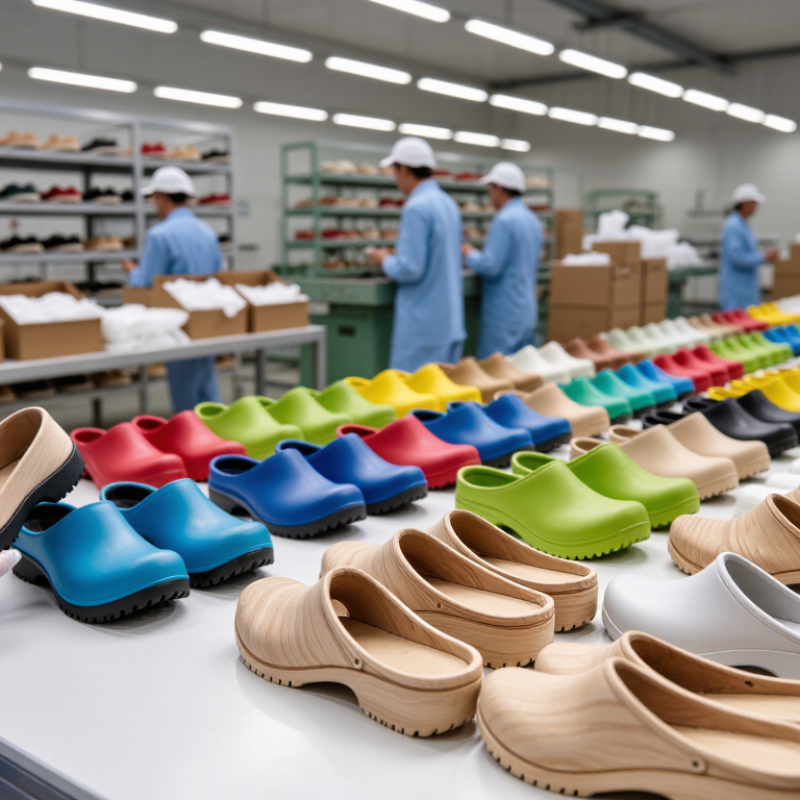
China’s Clog-Shoe Supply Base: HS 6402–6404, Export Clusters, and Factory Scale
China’s clog-shoe supply base is broad, but HS classification needs careful checking. HS 6402 generally covers footwear with rubber or plastic uppers and soles. HS 6403 covers leather uppers, while HS 6404 covers textile uppers with rubber or plastic soles. A clog’s material, construction, and sole design can change its classification. Confirm the code with a qualified customs professional before shipment.
Export clusters show different strengths. Jinjiang and nearby Fujian areas offer strong molding capacity and mature export services. Zhejiang factories often support flexible production and fast sampling. Guangdong suppliers can provide varied materials, packaging, and accessory options. Factory scale differs sharply. Some workshops produce a few hundred pairs daily, while integrated plants manage molds, injection lines, size grading, inspection, and container loading. During factory visits, I would check ventilation, mold storage, sole bonding, and carton drop-test records. Paper promises are not enough.
Tips: Request a material sheet, production flow, and recent inspection report. Ask whether the quoted capacity applies to clogs, not all footwear. Confirm the minimum order quantity by color and size. Sample approval should include weight, odor, sole grip, strap strength, and fit. Small details matter. A factory may look efficient, yet miss size consistency during peak months. Buyers should allow time for corrections, because a perfect first sample is not always a perfect production run.
Material Selection by EVA Density, PVC Durability, Rubber Grip, and 200–300% Elongation
China Best Clogs Shoes Suppliers for Global Buyers?
Material selection should match the buyer’s working environment. EVA density affects weight, cushioning, and shape retention. Lower-density EVA feels softer underfoot. It may compress faster during daily warehouse use. Higher-density EVA supports heavier users, but can feel less comfortable. Ask suppliers for density, hardness, compression-set, and aging data, not only samples.
PVC offers strong abrasion resistance and simple cleaning. It suits wet floors and routine industrial use. However, PVC can become less flexible in cold conditions. Rubber usually provides better grip on smooth or oily surfaces. Test slip resistance under wet conditions using recognized methods, such as ISO 13287 or ASTM F2913. Laboratory results still need field checking. Real floors are rarely perfect.
For flexible uppers and straps, 200–300% elongation sounds useful. Yet elongation alone does not prove long service life. Buyers should request tensile strength, tear strength, recovery, and repeated-flex testing. ASTM D412 supports rubber testing, while ASTM D638 is common for plastics. The OECD Global Plastics Outlook reported 353 million tonnes of plastic waste in 2019, with waste potentially reaching 1,014 million tonnes by 2060. Material efficiency matters. Recycled content may help, but inconsistent quality can increase defects. A supplier’s test report should show batch numbers, test conditions, and laboratory identity. Some factories provide impressive figures. The uncomfortable question is whether those figures match production pairs.
Supplier Verification Using ISO 9001, BSCI, SEDEX, and EN ISO 20347 Compliance
China Best Clogs Shoes Suppliers for Global Buyers?
Supplier verification should begin with evidence, not attractive product photos. The ISO Survey 2022 recorded 1,265,216 ISO 9001 certificates worldwide. This figure shows broad adoption, but certification alone proves little about current clog production. Request the certificate number, issuing body, scope, expiry date, and factory address. Then compare them with the audit report and production site. In practical sourcing work, mismatched addresses often deserve closer inspection. A valid ISO 9001 system should control incoming materials, molding records, defect handling, and corrective actions.
BSCI and SEDEX require careful interpretation. BSCI is an ethical-audit framework, while SEDEX is a data-sharing platform, not a product certificate. Ask for recent audit dates, worker interview coverage, unresolved findings, and remediation evidence. The ILO’s 2023 estimates link work-related factors to nearly 2.93 million deaths annually, making social compliance a serious purchasing issue.
EN ISO 20347 verification is equally practical for occupational clogs. Check test reports for slip resistance, impact performance, ergonomic design, and material durability. The report should identify the exact model, not merely a factory series.
Certificates can age quickly. A supplier may pass an audit, then change materials or subcontract processes. That uncomfortable gap needs monitoring. A small pre-shipment sample, batch traceability, and independent retesting can expose problems before containers leave China.
Global Buyer Costs: MOQ, 30–45-Day Lead Times, Incoterms, and Landed Pricing
China Best Clogs Shoes Suppliers for Global Buyers?
Choosing a reliable clogs supplier requires more than checking product photos. Buyers should compare material specifications, mold quality, factory capacity, and export experience. A typical MOQ may range from 500 to 2,000 pairs per color or style. Custom soles, packaging, and logos can increase this threshold. Always request a pre-production sample. Small details matter.
A 30–45-day lead time is common after sample approval and deposit confirmation. Ask whether this includes material purchasing, production, inspection, and packing. Incoterms also change the real cost. FOB usually leaves ocean freight and import charges to the buyer. CIF includes freight and insurance to the destination port. DDP may simplify delivery, but duties, taxes, and local compliance must be clearly documented. Landed pricing should include product cost, inland transport, freight, insurance, customs duties, broker fees, and final delivery.
The estimate may still be imperfect.
Tips: Request a written quotation with MOQ, payment terms, carton dimensions, and production milestones. Compare landed cost, not unit price alone. Use a third-party inspection before shipment when the order is significant. Confirm customs classification with a qualified local adviser. A low quote can hide expensive freight or weak packaging. Review the numbers again before placing the order.
Quality Control Standards: AQL 2.5, 100% Visual Checks, and ASTM F2413 Testing
China Best Clogs Shoes Suppliers for Global Buyers?
Reliable clog suppliers should show measurable quality controls, not only attractive samples. AQL 2.5 provides a practical acceptance level for batch inspections. Inspectors check stitching, bonding, sizing, color, odor, and surface damage. However, AQL is not a promise of perfection. It is a sampling method with defined limits.
A 100% visual check adds another safety layer. Each pair should be examined under clear lighting before packing. Inspectors can find loose straps, uneven soles, glue marks, or sharp edges. These details often disappear in factory photos. For protective clogs, ASTM F2413 testing may assess impact resistance, compression resistance, and other safety requirements. Buyers should confirm the exact tested construction. A casual clog cannot automatically claim protective performance.
Tips: Request recent inspection records, test reports, material specifications, and corrective-action evidence. Ask how failed pairs are isolated and rechecked. Confirm that the tested model matches the production model. A strong supplier welcomes independent inspections. Still, our process can improve. Human visual checks may miss hidden weaknesses. Regular training, calibrated equipment, and repeat testing reduce that risk. Clear records also make supplier comparisons more reliable.
Quality Control Reference Points for Global Clog Shoe Buyers
The chart summarizes commonly specified control references: 100% visual inspection coverage, an AQL 2.5 acceptance level for the applicable defect category, and ASTM F2413 testing when footwear is marketed as protective footwear. AQL is a sampling criterion, while ASTM F2413 is a performance standard rather than a defect percentage.