7 Tips for Buying a Leather Recliner Sofa Set
A Leather Recliner Sofa Set can turn an ordinary living room into a place for slow evenings, shared films, and afternoon naps. Yet soft cushions and polished leather do not guarantee lasting comfort. The right choice depends on fit, construction, room layout, and how your household will use it. Small details matter. A footrest that stops short, a handle that feels awkward, or a sofa that blocks a doorway can become daily annoyances.
Ergonomist Dr. Alan Hedge is often associated with the reminder, “The best posture is your next posture.” That idea is useful when comparing recliners: look for support across several positions, not just a pleasant first impression. Sit with your feet supported. Test the backrest and footrest together. Check whether the controls are easy to reach, and leave enough space behind or in front for the reclining mechanism. If children or pets share the room, consider how the leather’s finish may handle everyday wear.
This guide offers seven practical tips for buying a Leather Recliner Sofa Set, from assessing leather quality to checking frame strength and measuring your space. It also asks a less glamorous question: will you still like the sofa after years of use? A showroom can make almost any seat feel perfect for five minutes. Take your time, compare specifications, and remember that “genuine leather” alone does not explain the full quality or durability of a piece.
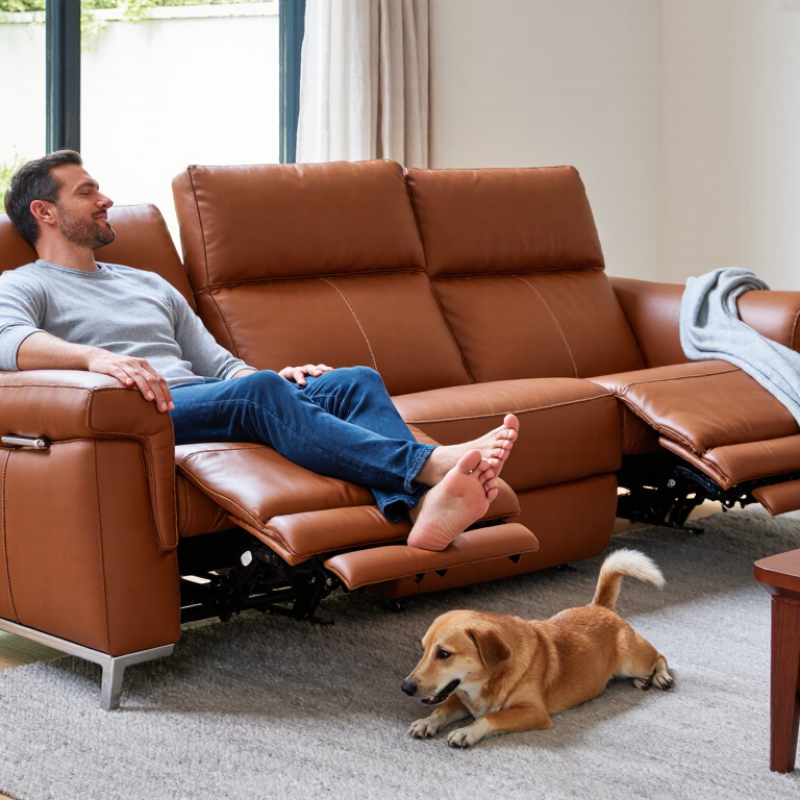
Assess Your Space, Seating Needs, and Budget
Before choosing a leather recliner sofa set, measure the room and every doorway along its delivery route. A sofa that fits the floor plan may still fail at a narrow hall or sharp turn. Leave space behind the recliner, too; some designs need several inches to tilt back. Check the maker’s measurements for the fully open position, not just the upright depth. Measure twice. It sounds fussy, but guessing can be expensive.
Think about who will use the seats and how they relax. A household that watches films together may value wide seats and easy-to-reach controls, while a smaller room may suit a compact two-seat arrangement. If possible, sit in a similar recliner for several minutes and notice whether your feet rest comfortably and the back supports your shoulders. Body proportions vary, so a popular size is not automatically the right one. I would also question whether every seat needs to recline; that feature can add cost and bulk.
Set a budget that includes more than the listed price. Delivery, assembly, protective treatments, and future care products may add to the total. Ask what the leather covers: some sets use leather on seating surfaces and a different material elsewhere. Read the care instructions before buying, especially if sunlight reaches the sofa or pets share the room. A little uncertainty is useful here; room layouts and daily habits change, and the cheapest option may not stay practical.
Compare Leather Types, Grades, and Finishes
When comparing leather recliner sofa sets, look beyond the word “leather.” Full-grain leather keeps the natural surface, including small marks, and usually develops a patina with use. Top-grain leather has its surface lightly corrected, so its appearance is more uniform. Split leather comes from lower layers of the hide and may receive a coating. Bonded leather contains leather fibers and binders; it can look convincing, but its surface may wear differently over time. Ask exactly which parts of the sofa use each material.
Grades are not standardized across every seller. One retailer’s “premium” grade may not match another’s. Ask for the hide type, where it is used, and a written care guide. Feel a sample if possible. Does it feel supple, or stiff and plastic-like? Check the seat edges, armrests, and footrest, where repeated movement can reveal weak finishes sooner. I once judged a sample by its smooth surface alone. That was not enough.
Finish affects both appearance and upkeep. Aniline leather shows natural color variation and feels soft, but it can absorb spills and fade in strong sunlight. Semi-aniline adds a light protective layer while retaining some visible grain. Pigmented leather has a more consistent color and usually handles daily wiping better, though it may feel less natural. Ask how to clean the exact finish, not leather in general. Then compare samples in your room’s light; showroom lighting can be flattering, sometimes too flattering.
7 Tips for Buying a Leather Recliner Sofa Set: Compare Leather Types, Grades, and Finishes
Scores show general tendencies on a relative 1–5 scale, not standardized test results. Aniline leather usually shows the hide’s natural character but needs more careful maintenance; pigmented, protected finishes generally resist stains better and are easier to care for. Leather-grade terms can vary between sellers, so ask about the hide layer and finish.
Evaluate the Frame and Reclining Mechanism
A recliner’s frame is easy to overlook beneath thick cushions. Check the underside for solid, well-joined hardwood or quality plywood, not loose staples or rough, split edges. Press gently against the arms and back; creaks or shifting joints deserve attention.
The USDA Forest Products Laboratory’s 2021 Wood Handbook explains that wood changes dimension as its moisture content changes. That matters in a sofa frame: stable joinery and properly dried wood can help limit movement over time.
Still, a heavy sofa is not automatically a sturdy one.
Test the reclining mechanism several times, both with and without someone seated. The footrest should extend smoothly, lock securely, and return without scraping the floor. Listen closely. A sharp clunk or uneven motion may signal poor alignment or loose hardware.
EN 12520:2015 specifies 25,000-cycle durability tests for domestic seating, a useful reference for seat and back performance, though it does not certify a recliner’s mechanism. Ask whether the seller can provide test documentation for the complete reclining unit, including its intended cycle count.
Also inspect accessible pivot points and metal linkages for wobble, exposed sharp edges, or pinch gaps. One imperfect shortcut is judging by a quick showroom test; repeated use can reveal problems that a single try cannot.
I would check the return and repair terms, too. They are easy to forget.
Check Comfort, Fit, and Useful Features
Comfort is personal, so test a leather recliner sofa set in the position you use most. Sit back for several minutes, not just a quick showroom check. Notice whether your lower back feels supported and your feet rest comfortably when the footrest is raised. Stay seated. A headrest should meet your neck without pushing your chin forward, and the seat should feel supportive rather than hard at the edges. If two people will share the sofa, test it together; a comfortable fit for one person may feel cramped for another.
Measure the room, doorway, and route into the house before choosing a set. Record the sofa’s width and depth, then check how far it extends when fully reclined. Leave enough space to walk past it without turning sideways. A paper outline on the floor can help you picture its footprint. It is easy to forget clearance behind the sofa, especially when a model reclines away from the wall.
Useful features should solve everyday problems. Compare manual and powered mechanisms, and operate each recliner several times to check for smooth, steady movement. Built-in USB ports may be handy, but consider whether the outlet is within reach. Look closely at stitching, seams, and leather care instructions. More functions can mean more parts to maintain; that trade-off is worth thinking through. I would not choose extra features before confirming the sofa fits the room and feels right.
Review the Price, Warranty, and Care Requirements
A leather recliner set can look affordable until delivery, assembly, and room-clearance costs appear. Ask for an itemized quote, including taxes and any fees for carrying the sofa upstairs. Compare the same details across options: seating size, leather coverage, frame materials, and reclining mechanism. Some sets use leather only on contact surfaces, with matching material elsewhere. That may suit your budget, but confirm it in writing. A low price alone tells you little.
Read the warranty before you pay. Check how long the frame, reclining mechanism, and upholstery are covered, since they may have different terms. Look for exclusions involving normal wear, stains, or frequent use. Ask who handles service and whether labor or transport is included. Keep the answer with your receipt. Read the exclusions carefully.
Care needs vary with the leather finish. Ask which cleaner and conditioner are suitable, and test any product on a hidden area first. Wipe spills promptly with a soft cloth; avoid soaking the surface or using household sprays. Keep the sofa away from strong sunlight and heat, which can fade or dry leather. Vacuum crumbs from the seams. A light-colored finish may show denim transfer sooner than expected. It is easy to focus on appearance and overlook upkeep; choose a finish you can realistically maintain.
7 Tips for Buying a Leather Recliner Sofa Set — Review the Price, Warranty, and Care Requirements
| Tip | What to Review | Practical Checks | Useful Reference |
|---|---|---|---|
| 1 | Set a realistic budget | Compare the full set price, including delivery, assembly, taxes, and any optional protection plan. Check whether the quoted price is for genuine leather on all seating surfaces or a mix of materials. | Prices vary widely by size, construction, upholstery, and retailer. Treat online price ranges as estimates and compare like-for-like configurations. |
| 2 | Identify the upholstery | Ask which parts are covered in leather and which, if any, use matching vinyl or another upholstery. Request the leather type and care instructions in writing. | “Leather match” commonly means leather on some contact areas and a non-leather material on other panels; exact coverage should be confirmed with the seller. |
| 3 | Compare warranty coverage | Read the warranty for separate terms covering the frame, reclining mechanism, upholstery, and cushions. Check the coverage period, exclusions, labor charges, and whether shipping is your responsibility. | Warranty length and coverage differ by product and seller. A longer term does not necessarily mean every component is fully covered for that entire period. |
| 4 | Test comfort and operation | Sit in each seat and test the recline several times. Check lumbar support, seat depth, footrest extension, head support, and whether the control is easy to reach. | If buying online, review the return window and who pays return freight for large furniture before ordering. |
| 5 | Measure the room and route | Measure the sofa, doorways, hallways, stairways, and the space needed behind or in front of the recliner. Confirm whether the unit requires wall clearance to recline. | Use the product’s open and closed dimensions when available; a reclining sofa may need more room when its footrests are extended. |
| 6 | Understand routine care | Follow the manufacturer’s instructions for the specific leather finish. Wipe spills promptly with a soft cloth and avoid unapproved cleaners, solvents, and abrasive products. | Care needs vary by leather type and finish. Test any approved cleaner on a hidden area first, and keep leather away from prolonged direct sunlight and heat. |
| 7 | Check construction and service | Ask about the frame, reclining mechanism, assembly requirements, replacement-part availability, and how to arrange service. Inspect stitching and moving parts where possible. | Confirm whether delivery includes room-of-choice placement, assembly, and packaging removal; these services may cost extra or vary by location. |