2026 Top Cart Pen Types What Should Global Buyers Choose?

Choosing the right Cart Pen in 2026 requires more than comparing appearance and wholesale price. Global buyers must examine construction, compatibility, safety documentation, and intended legal use. A dependable device should feel balanced in the hand, connect securely, and maintain consistent performance during ordinary testing. Small details matter, including charging protection, airflow design, mouthpiece quality, and packaging clarity.

Common options include disposable models, rechargeable 510-thread devices, ceramic-cartridge systems, and adjustable-voltage designs. Each type serves different purchasing conditions. Disposable units simplify distribution but create more packaging waste. Rechargeable models may reduce repeated replacement, yet they require reliable charging instructions and stronger quality control. Ceramic heating components can support cleaner flavor performance, although supplier claims should be verified through independent testing.

Evidence matters.

Professional buyers should request material specifications, batch records, battery test reports, and certificates from recognized laboratories. They should also confirm whether the product complies with destination-market rules, labeling requirements, recycling obligations, and age-related restrictions. Regulations can differ sharply between countries and may change during a product cycle. A supplier’s confident statement is not enough.

There is no universal best choice. A compact disposable Cart Pen may suit controlled sampling, while a rechargeable model may better support established retail channels. However, sustainability, repairability, and total ownership costs deserve closer attention than they often receive. Some products look impressive online but perform poorly after transport or storage. Buyers should test samples under realistic conditions, document defects, and compare several suppliers before making a large commitment. Even this approach is imperfect, but careful verification reduces avoidable risk.
2026 Top Cart Pen Types What Should Global Buyers Choose?

Cart Pen Basics: Definition, Structure, and Core Functions

Cart Pen Basics: Definition, Structure, and Core Functions

A cart pen is a compact, battery-powered device for heating a compatible, legally permitted cartridge. It should not be confused with a universal container. Cartridge fit matters. Most designs include a mouthpiece, cartridge chamber, heating element, battery, airflow path, and charging port. Some models use a button, while others activate through inhalation. Small indicators may show charging, activation, or low power.

The cartridge holds the selected liquid, while the heating element creates controlled warmth. The airflow path directs vapor toward the mouthpiece. Good structure should limit leakage and keep the cartridge stable during transport. Materials deserve close attention. Buyers should request information about the cartridge housing, seals, electrical protection, and temperature control. A smooth finish looks useful, but internal quality matters more.

In practical sourcing, test samples before placing a large order. Check threading, airflow resistance, charging time, and repeated activation. Ask for independent safety and performance reports where available. Published specifications can miss real-world details. That is easy to overlook. A pen may fit perfectly yet feel uncomfortable during use. Battery capacity also varies under actual operating conditions. Global buyers should confirm local product rules, shipping requirements, labeling duties, and disposal expectations. No single cart pen type suits every market. Sometimes, the simplest structure proves more dependable.

2026 Top Cart Pen Types: Typical Cartridge Capacity

Cartridge and pod capacities vary by market and product configuration. The chart uses representative nominal fill volumes commonly specified for commercial cart pen formats, without using company or brand data.

510-threaded systems are widely used because the cartridge and battery can be sourced separately. Pod-style systems generally prioritize compact handling and easy replacement. All-in-one rechargeable pens combine the battery and cartridge in one body, while disposable pens normally emphasize convenience and require no charging or cartridge replacement.

Major Cart Pen Types and Their Key Differences

2026 Top Cart Pen Types: What Should Global Buyers Choose?

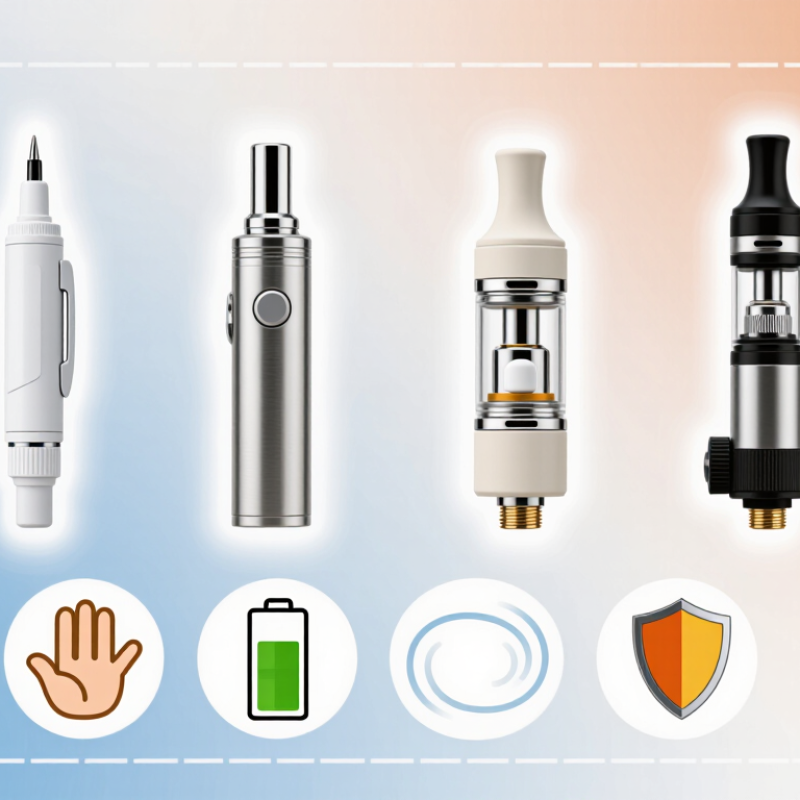
Major cart pen types differ in structure, compatibility, control, and purchasing risk.

The 510-thread cart pen remains widely used because its screw connection supports replaceable cartridges.

However, thread quality can vary, and poor alignment may cause leakage or unstable heating.

Buyers should confirm thread standards, battery output, and cartridge dimensions before placing large orders.

Integrated pod pens combine the battery and pod in one matched system.

They are simple to operate and often provide better airflow consistency.

This design can reduce compatibility problems, but it creates more packaging waste and limits replacement flexibility.

Disposable pen formats are compact and convenient, yet buyers should examine battery protection, sealing, recycling options, and transport requirements for each market.

Local regulations may differ sharply.

Button-activated models offer control over heating time, while draw-activated models provide easier handling.

Ceramic heating elements may deliver even performance, but material quality still matters more than marketing language.

Ask suppliers for test reports, leak testing, battery safety records, and batch traceability.

I have seen buyers focus too heavily on unit price. That choice often becomes expensive after returns and complaints.

A practical sample review should check mouthpiece fit, airflow, charging behavior, surface temperature, and performance after storage. Small details matter.

Performance, Compatibility, and Safety Factors for Global Buyers

Choosing among 2026 cart pen types requires more than comparing appearance or battery size. Ceramic-based designs often provide consistent heating and cleaner flavor for compatible, legally sold formulations. Wick-based designs may cost less, but they can produce uneven vapor when the liquid is thick or the device is stored cold. Refillable systems offer flexibility, while sealed cartridges usually reduce handling and leakage risks. Performance depends on the cartridge, heater, battery, and formulation working together.

Compatibility is the practical test. Buyers should confirm connection size, resistance range, charging specifications, and liquid viscosity before placing large orders. A pen that works well in a warm warehouse may perform poorly during winter transport.

Regional electrical requirements also matter. USB charging is convenient, but weak cables and poor power control can create avoidable hazards. Small details matter.

Safety evidence should be documented, not implied. Request material declarations, battery protection information, leak testing, thermal cutoff data, and production traceability. Food-contact suitability does not automatically prove suitability for heated applications. That assumption is easy to make.

Child-resistant packaging, clear instructions, age-gated sales, and compliant labeling should match the destination market. Independent testing is valuable, although it cannot replace supplier audits or sample inspections.

Buyers should test several production batches, because one successful sample may hide inconsistent manufacturing. There is no universally best cart pen; the strongest choice is the one whose performance, compatibility, and safety records remain reliable across real shipping conditions.

How to Match Cart Pen Types With Use Cases and Markets

Global buyers should match cart pen types with local use cases, not chase the newest shape. Draw-activated pens suit first-time adult users because they remove button confusion. Button-activated models offer better control for experienced users, especially in colder environments. Ceramic heating systems can support consistent flavor, but quality depends on testing and temperature control.

Grand View Research valued the global e-cigarette market at about USD 28.17 billion in 2023. Its forecast also expects strong growth through 2030. That figure signals demand, not automatic product suitability. In Europe, buyers should examine nicotine limits, labeling rules, and child-resistant packaging. In North America, state and national requirements may differ. A universal product strategy can fail quickly.

Match battery size to real usage. A compact pen fits urban retail and short carrying periods. A larger battery may serve frequent users, but it adds weight and shipping concerns. For humid markets, sealed construction and leak testing matter. For colder markets, battery performance deserves closer review. The U.S. FDA emphasizes manufacturing controls and product compliance, while the World Health Organization continues to highlight youth protection and packaging risks. Buyers should request laboratory reports, batch records, and electrical safety evidence. I would also test mouthpiece comfort in local conditions. Small details can change repeat purchasing.

2026 Buying Criteria: Quality, Compliance, Cost, and Supply Stability

2026 Top Cart Pen Types: What Should Global Buyers Choose?

Global buyers in regulated markets should compare three formats: reusable 510-thread pens, sealed pod systems, and all-in-one devices. Each serves a different procurement reality. Reusable hardware can reduce packaging, but connector tolerances and replacement-part availability require testing. Sealed systems simplify handling, yet create stronger dependence on one cartridge specification. All-in-one units may reduce assembly steps, but battery waste becomes harder to control.

Quality begins with measurable evidence, not polished samples. Request batch-level certificates for battery safety, materials, leakage, electrical performance, and contaminant screening. IEC 62133-2 testing supports portable lithium battery safety, while ISO 9001 evidence can clarify production controls. For Europe, check RoHS, REACH, and applicable battery regulations. Rules differ by market. Do not treat one certificate as global approval. That mistake is common, and costly.

Cost should include tooling, inspection, freight, duties, warranty returns, and minimum order quantities. The 2024 Global E-waste Monitor recorded 62 million tonnes of e-waste in 2022. Only 22.3% was documented as properly collected and recycled. The World Bank’s 2023 Logistics Performance Index highlights customs, infrastructure, and shipment timeliness. Ask suppliers for dual-source components, safety stock, and realistic replenishment schedules.

Tips: Approve a pilot batch, arrange independent inspection, and test samples after vibration and temperature exposure. Do not skip the unpleasant failure review. Perfect forecasts rarely exist.

2026 Top Cart Pen Types: What Should Global Buyers Choose?
2026 Buying Criteria: Quality, Compliance, Cost, and Supply Stability
Cart Pen Type Best-Fit Use Case Typical Battery / Power Heating System Typical Hardware Materials Indicative FOB Cost* Typical MOQ Typical Production Lead Time Quality and Compliance Priorities Supply Stability Global Buyer Assessment
510-Thread Rechargeable Battery Pen Reusable systems using replaceable 510-thread cartridges; suitable for broad cartridge compatibility. 280–650 mAh; USB-C charging is increasingly preferred. Threaded ceramic or metal heating element; often button-activated or draw-activated. Aluminum alloy body, stainless-steel connection, lithium-ion battery, polymer mouthpiece. US$1.20–US$3.80 per unit, excluding cartridge, freight, duties, and taxes. 500–3,000 units 15–30 days after artwork and component approval. 510-thread dimensional accuracy, battery protection, charging safety, leakage prevention, RoHS, REACH, and transport documentation for lithium batteries. High The most flexible option for multi-market programs because the battery and cartridge can be sourced or replaced separately.
Button-Activated Variable-Voltage 510 Pen Users who require adjustable power for different oil viscosities and cartridge resistance levels. 350–650 mAh; commonly supports two or more voltage settings. Low-temperature ceramic or metal coil with electronic voltage control. Aluminum or zinc-alloy housing, stainless-steel connector, lithium-ion cell, tactile button. US$1.80–US$4.80 per unit, excluding cartridge, freight, duties, and taxes. 500–2,000 units 20–35 days, depending on firmware and packaging requirements. Voltage accuracy, button life, short-circuit protection, overcharge protection, over-discharge protection, thermal testing, RoHS, REACH, and applicable battery safety evidence. Medium–High A strong choice when performance control is more important than the lowest purchase price.
Draw-Activated Disposable All-in-One Pen Ready-to-use products focused on convenience, simple operation, and limited user interaction. 280–600 mAh; single-use or non-serviceable rechargeable designs are common. Integrated ceramic or mesh heating element controlled by an airflow sensor. Aluminum body, plastic or glass reservoir, stainless-steel vapor path, lithium-ion cell. US$1.50–US$4.50 per unit, excluding filled contents, freight, duties, and taxes. 1,000–10,000 units 20–45 days, including assembly, testing, and customized packaging. Airflow sensitivity, activation reliability, leak and drop testing, child-resistant packaging where required, battery transport compliance, RoHS, REACH, and market-specific product rules. Medium Efficient for high-volume launches, but recycling obligations, regulatory restrictions, and battery availability must be evaluated carefully.
Rechargeable Ceramic-Core All-in-One Pen Premium positioning where vapor consistency, flavor preservation, and reduced disposable waste are priorities. 350–650 mAh; USB-C charging and automatic draw activation are common. Ceramic-core heating element designed for controlled and relatively uniform heating. Aluminum alloy, ceramic heating core, stainless-steel vapor path, glass or polymer reservoir. US$2.20–US$5.50 per unit, excluding filled contents, freight, duties, and taxes. 1,000–5,000 units 25–45 days because ceramic components and leak testing can extend production. Heating uniformity, oil compatibility, material migration testing, leak resistance, charging-cycle testing, battery protection, RoHS, REACH, and packaging compliance. Medium–High Suitable for buyers willing to pay more for performance and a more durable product architecture.
Closed Pod-Style Rechargeable Pen Controlled-format systems requiring a proprietary or semi-proprietary pod connection and stronger product ecosystem control. 350–800 mAh; USB-C charging is typical for reusable devices. Integrated ceramic or mesh element matched to a specific pod design. Aluminum or polymer body, stainless-steel contacts, molded pod housing, lithium-ion cell. US$2.50–US$6.50 per device, excluding pods, filled contents, freight, duties, and taxes. 1,000–5,000 devices 25–50 days, especially when custom pod tooling is required. Pod-to-device fit, contact reliability, leak testing, electrical protection, material compatibility, child-resistant packaging where required, RoHS, REACH, and local market requirements. Medium Can improve user retention and format control, but creates greater dependence on compatible pod tooling and component supply.
High-Capacity Dual-Cartridge Pen Users needing two cartridge positions or switching between two formulations in one device. 600–1,000 mAh; independent or alternating channel control may be available. Two independent ceramic or metal heating channels with electronic control. Aluminum or zinc alloy, stainless-steel connectors, lithium-ion battery, dual-channel circuit board. US$3.50–US$8.00 per unit, excluding cartridges, freight, duties, and taxes. 1,000–3,000 units 30–55 days because of additional electronics and functional testing. Channel isolation, balanced power delivery, button and display reliability, thermal protection, drop testing, battery safety, RoHS, REACH, and market-specific requirements. Medium Best for specialized product lines; higher complexity increases inspection needs, defect risk, and landed cost.
Buyer Notes
* Cost ranges are indicative bulk FOB estimates for empty hardware and are provided for preliminary comparison only. Actual prices vary by battery capacity, materials, heating technology, customization, testing, order volume, packaging, and payment terms.
Compliance requirements vary by destination and intended use. Buyers should verify applicable electrical, battery transport, chemical, packaging, recycling, labeling, age-restriction, and product-specific regulations before placing an order.
For lithium-ion products, request current safety test evidence, transport documentation, production inspection records, battery traceability, and samples from the final production configuration.

Find Mitten in Michigan

Request Mitten Near You

Have a favorite dispensary that doesn't carry Mitten Extracts yet? Let us know, and we'll work to make sure our premium products are available where you shop.